Showing posts with label Spekboom. Show all posts

Wednesday, 17 June 2020

Thirst, starve or susceptibility? Elucidating to physiological driver of canopy tree mortality in transformed arid Thicket.

by Daniel Buttner 

As we know Thicket has experienced considerable transformation shifting from a highly conserved resource sink ecosystem to an ephemeral based one (see Lechmere-Oertel et al., 2005). This change in resource dynamics has consistently been demonstrated via fence-line contrasts where extensive browsing, chiefly by goats, has degraded the landscape, removing key species contributing to both ecosystem productivity and functionality, such as the dominant succulent Portulacaria afra (spekboom) and the many "palatable" species.

While extensive work has been conducted on the overall pattern or rather impact of browsing on thicket by quantifying the loss of species as well as looking into the soil geochemical and physical properties, there is little to no physiological research, particularly drought work. This is quite paradoxical considering the general notation and subsequent recognition of thicket species as being drought tolerant, yet citing no empirical data to back up said suppositions. Irrespective of this quantitative data absence several anecdotal observations might through a "spanner in the works" of drought-tolerance assumption in thicket. Yes, the distributional range of thicket, specifically arid subtypes, appear to support this drought tolerance notion. However, much as the subtropical trees in these systems persisting beyond their respective physiological optimum, so does the question as to why in transformed arid thicket do the trees, which have escaped considerable herbivory damage  by goats are slowly beginning to vanish from these transformed landscapes. Such a disappearance would seem to contradict the notion of drought tolerance capabilities of these ancient, resource conservative trees (most commonly Pappea capensis and Euclea undulata). The expatriation has considerable repercussions for the stability and subsequent conservation efforts of subtropical thicket, particularly arid types.

I believe, or more accurately speculate, that many of the tree species are relying on a quite elusive symbiosis. What we in the Potts Research Group have come to fondly call the "Spekboom Sponge Hypothesis" (see The Spekboom Sponge Hypothesis or SSH) which posits that trees and other shrubs exploit P. afra as a physiological refugia, abstracting necessary water requirements during protracted drought (both frost drought and arid drought conditions) periods in arid Thicket. Under the SSH we might expect that thicket trees might experience greater physiological strain than those in transformed sites (spekboom the first causality to goat herbivory).

The removal of this dominant succulent has a substantial impact on the fundamental ecosystem functions, ranging from soil stabilization to gross carbon sequestration. While the role of P. afra as an ecosystem engineer is undisbuted but its relevance as a nurse plant, as suggested in Adie & Yeaton (2013), and subsequent effects as a physiological refuge from water constrained conditions remains elusive and is need of  discussion. Many studies have attempted to capture nurse plant effects or rather ascertain whether a foundational species (synonymous with ecosystem engineer) can be characterized as a nurse plant. Conventional approaches employ spatial association analyses (proximal distance between individuals to calculate a "Zone of Influence"), the second more commonly applicable approach is removal of the suspected nurse plant and document changes resident species functional traits, often phenological and health indices, with the rare appearance of a physiological metrics (see Brooker et al., 2008) to infer a reduction in stress condition of benefiters near a suspected nurse plant.

While such a removal experiment would not only be impractical but also extremely expensive to undertaken. However, in thicket we are fortunate (I use the term loose here) that goat browsing has provided us with just such an opportunity by preferentially consuming the more palatable species first, i.e. succulents, lianas and eventually spinescent shrubs, leaving only those capable of physical escape, such as the trees who's foliage exists beyond the vertical reach of goats are but the few species to have survived in these landscapes. Although, totally by coincidence have these trees escaped the first round of biophysical disturbance, yet little do they realize the second round is on its way. By removing the undergrowth, goats have unintentionally removed the majority of the Thicket canopy heightening the evaporative demand on near-surface water-soil horizons, actualizing a localized aridity gradation of  the soil matrix placing considerable physiological strain on remnant trees. The impacts of such an aridity gradient is a completely loss of the foundational microclimate needed for seedling establishment and essential for future tree recruitment success in arid thicket. The image below illustrates this quite well, with the sheer abundance of Pappea capensis skeletons outnumbers the living.

Aerial imagery taken in transformed landscape illustrating the numerous Pappea capensis skeletons (red circles) throughout indicative of future expatriation of these trees within this landscape. Note the blue circle, this individual has lost half its canopy cover with the remaining stems bleached white stems indicative of dead tissue. I suspect this individual to have surpassed a critical threshold of mortality likelihood and the foliage persisting is simply the remnant metabolic legacy of the plant, and has cascading hydraulic failures due to the inability to maintain a positive net carbon balance.

While it is quite apparent as to the outcome of goat browsing, i.e. loss of thicket wholeheartedly, the reasons for why the trees and a few spinescent shrubs (pers. obs. Carissa haematocarpa) are eventually expatriated from the landscape — the underlying physiological mechanism rationalizing their lose is yet to ascertain. From the actualization of aridity gradation transitioning between intact to transformed, many would posit drought or rather more specifically drought susceptibility, contrary to the long-held belief of drought tolerance of thicket. While I can only speculate at this moment to the hydraulic vulnerability of these trees there are shared similarities in anecdotal observations made with other classic drought based model systems, such as the Pinyon-Juniper woodlands in the USA (Mueller, et al., 2005). This classic example contrasts to dominant species as polar opposites in their respective drought response strategies and have ever since been cited as the benchmark for analogous reviews and comparative analyses for interpreting drought responses by other arid forest ecosystems or those experiencing seasonal water deficits.

Here I illustrate the strong comparative analogs using a single dominant tree species found throughout the Subtropical Thicket biome, Pappea capensis, placing it in context of the proposed hydraulic framework by McDowell et al., (2008) attributing tree mortality to two main hypotheses. The first being the hydraulic failure hypothesis, which attributes the success of a species under drought to have a well structured and supportive conductance system, enabling stomatal activity to go unimpeded during drought, thus anisohydric species where the whole-plant water potential follows closely that of soil (i.e. environment). Anisohydric species fluctuate minimally in their respective stomatal conductance ensuring carbon assimilation is not impact by drought. However, for the plant to ensure water continuity its imperative that a well supported hydraulic architecture capable of enduring extremely water potentials and potential for cavitation and subsequent emboli during protracted dry spells — anisohydric species as the risk takers and most vulnerable to hydraulic failure. Whereas isohydric species coordinate hydraulic traits to avoid the physiological strain expressed upon them during water deficiencies, maintaining whole-plant water potential at more positive pressures than those experienced those of the soil, this ensures that the plant is unlikely to experience cavitation or possible hydraulic dysfunction during drought conditions. However, by limiting or rather stringently controlling stomatal conductance these isohydric species have restricted photosynthetic activity, thus carbon assimilation. Isohydric species play it safe, as most often is the case that they are hydraulically vulnerable and thus take every effort to safeguard xylem conduits from cavitation and possible collapse. However, while attempting to avoid the hydraulic implications of drought they ran the risk of depriving themselves of necessary sugars, thus become carbon starved.

Conceptual hydraulic framework proposed by McDowell et al., (2008), illustrating the mortality trajectory of trees experiencing drought. Biotic agent susceptibility is either amplified or amplifying physiological stress.


An update of the hydraulic framework revised in McDowell (2011), which considers the dual strain placed on non-structural carbohydrates to mitigate hydraulic impairment via osmotic adjustment (production of stable solutes, e.g. proline) and having to ensure net carbon balance maintaining positive carbon turnover. This demand on carbon resources is evident by increased pest and pathogenic susceptibility. 

The carbon starvation and hydraulic failure hypotheses have been proposed the distinction isn't clear cut and is rather blurred. Both are presented as the physiological cause behind drought-induced tree mortality, differentiate on the basis of time to death. Where hydraulic dysfunction is anticipated over a series of months to years while carbon starvation is expected to occur over decades as the tree is carbon turnover is diminished progressively during drought cycles or decadal episodic events. A recent revision of the carbon starvation has additionally been proposed that illuminates hydraulic failure as more significant of the two as effecting mortality risk. McDowell (2011) revised the expectation under carbon starvation noting that during drought trees compensate for hydraulic impairment accumulating non-reactive solutes in their tissues increasing the osmotic potential and enable stomatal conductance to remain high even during water stress states prioritizing photosynthetic metabolism even during stress states. Now whether this is ineffectual photochemical quenching or interlink between nutrient assimilation, specifically nitrogen necessary for hormonal production and other signaling proteins for undertaking simultaneous responses during stressful conditions, remains speculative. However, what many researchers have reached a consensus on is the substantial effects of hydraulic impairment to the survival of trees in any environment experiencing drought or water deficit conditions.

Image of a physiologically taxed Pappea capensis situated in the transformed thicket landscape. A notable reduction in canopy foliage, not imposed by herbivory predominantly but rather as an evergreen (possible semi-deciduous) its leaves are hydraulically conservative (I speculate here no literature or data) thus are susceptible to emboli and subsequent photosynthetic impairment. (Image courtesy of Robbert Duker, May 2020)

Illustration of pest susceptibility of Pappea capensis individual in transformed site, note the numerous insects bore holes. A consequence of non-structural carbohydrate depletion reallocated for production of solutes for osmotic adjustments prioritising hydraulic conductivity over structural vulnerability and secondary metabolites preventing onslaught by pests. (Image courtesy of Robbert Duker, May 2020)

An intriguing outcome of either sequential losses in hydraulic conduits or depression of non-structural carbon turnover via stringent stomatal conductance, is the appearance of the comorbidity of increased  pest and/or pathogen susceptibility. Hence, biotic agents concurrently impact tree mortality either amplifying the physiological stress or enacted as a compounding factor. This impact strongly agrees the notion of allocation optimalty theory were carbon investment is prioritised to tissues or utilised in strategies that pose the greatest risk to survival of the plant. 

I have made several observations of pest susceptibility of the Thicket tree dominant Pappea capensis  that strongly agree with what we might expect under the hydraulic framework proposed by McDowell et al., (2008). There is a great demand for drought research both from a physiological and hydrological standpoint in Thicket as the existing climate change management outline for this biome operates under the historical notion of drought tolerant trees, yet for all we know these trees are persisting beyond their respective physiological optimum surviving within their "pseudo-realized niche" via interspecific facilitation with P. afra. Hence, the loss of this dominant ecosystem engineer has major ramifications for the sustainability of Thicket tree diversity in arid extensions of the Albany Subtropical Thicket biome. A great time to be a budding drought physiologists and Thicket ecologist, so many questions to ask and better still more experiments to run.


References:

Brooker, R.W., Maestre, F.T., Callaway, R.M., Lortie, C.L., Cavieres, L.A., Kunstler, G., Liancourt, P., Tielbörger, K., Travis, J.M., Anthelme, F. and Armas, C., 2008. Facilitation in plant communities: the past, the present, and the future. Journal of ecology, 96(1), pp.18-34. 

Lechmere‐Oertel, R.G., Cowling, R.M. and Kerley, G.I., 2005. Landscape dysfunction and reduced spatial heterogeneity in soil resources and fertility in semi‐arid succulent thicket, South Africa. Austral Ecology, 30(6), pp.615-624. 

McDowell, N., Pockman, W.T., Allen, C.D., Breshears, D.D., Cobb, N., Kolb, T., Plaut, J., Sperry, J., West, A., Williams, D.G. and Yepez, E.A., 2008. Mechanisms of plant survival and mortality during drought: why do some plants survive while others succumb to drought?. New phytologist, 178(4), pp.719-739.

McDowell, N.G., 2011. Mechanisms linking drought, hydraulics, carbon metabolism, and vegetation mortality. Plant physiology, 155(3), pp.1051-1059. 

Mueller, R.C., Scudder, C.M., Porter, M.E., Talbot Trotter III, R., Gehring, C.A. and Whitham, T.G., 2005. Differential tree mortality in response to severe drought: evidence for long‐term vegetation shifts. Journal of Ecology, 93(6), pp.1085-1093.

Monday, 6 April 2020

Frost synonymous with fire? The hydraulic death hypothesis in Thicket

by Daniel Buttner

Frost has been defined as a fundamental factor in dictating the biome boundary between Thicket and Nama-Karoo shrubland (see Image 1). The impacts of frost are numerous and have been discussed in a previous post by Dr. Robbert Duker (see Thicket restoration and frost: the forgotten enemies) , overall having detrimental impacts on photosynthetic efficiency of exposed individuals ( Duker et al. 2015).


Abrupt biome  boundary observed between Spekboom-dominated Thicket and Nama Karoo shrubland. (Photo: Robbert Duker, 2014).


This got me thinking that the effects of frost might also extend beyond the photosynthetic machinery of Thicket species (spekboom being primary focus here) and impact the structural components as well, specifically hydraulic conduits in the stem.

At this moment I would like to take a little detour, and chat about fire or more specifically the way in which fire is proposed to kill plants and relating this to the hydraulic death hypothesis (Midgley et al. 2011). To be brief, the hydraulic death hypothesis suggests that plant mortality following intense fire events can be attributed to hydraulic failure by cavitation due to sudden water deficiencies induced by heat plumes or by what Midgley et al. (2011) referred to as run-away hydraulic damage due to leaf water deficits where stomatal response to limit water loss was lagging behind the sudden burst of heat from the fire. Whether by run-away hydraulic failure or cavitation, there where three key predictions/expectations suggesting failure in hydraulic conductivity as the prime cause for mortality. Midgley et al. (2011) described these three predictors/expectations as: (1) post-fire mortality occurred a few days after the fire event, (2) death or damaged tissue was observed forming from the base upwards, (3) the mortality correlated negatively with stem diameter as opposed to height.


Image 2: A spekboom individual planted in a frost-prone area. (Photo: Robbert Duker, 2014)

This fundamental idea of cavitation got me thinking about spekboom and the Thicket Nama-Karoo biome boundary. First off when water freezes it expands and crystallizes, keep this in the back of your mind while we undertake a thought experiment. Imagine a straw with the ends of the straw capped and the tube filled with water, then placing the straw in your freezer. What would happen to that straw as it freezes, it would begin to expand until it burst at any point along its length.  This expanding straw metaphor is analogous to what we might expect in a plant stem comprising of hundreds and thousands of xylem vessels, little straws if you will, running the length of the stem. When frost occurs or rather the temperatures inducing frost formation, the water within these vessels freezes, crystalizes, and expands resulting in hydraulic dysfunction. There are two potential mechanisms of hydraulic dysfunction under frost, firstly, cellular puncture by water crystals resulting in cytoplasmic leakage or in the case of xylem vessels protrusions into surrounding tissue diminishing water driven potential created by intact xylem tissue. The second mechanism is expansion damage of vessel conduits preventing water mobility up the stem. Regardless of the mechanism the outcome is the same, failure in hydraulic conductivity subsequently resulting in mortality.

Bringing us back to the hydraulic death hypothesis in the case of fire there are three expectations, delayed mortality, bottom-up necrosis, and negative correlation of mortality with stem diameter as opposed to height. And while I can speak to the first two of these expectations under the hydraulic death hypothesis induced by frost conditions (see Image 2 as a summary image), the third requires some more data.


Image 3: Frost damage of a single spekboom individual transplanted into a frost-prone area at study site. Notice the damage is from the bottom progressing upwards conforming to the second expectation of the hydraulic death hypothesis (photo: Robbert Duker, 2014).

This "frost hydraulic death hypothesis" has yet to be tested explicitly but has great potential as an explanatory process beyond existing photosynthetic interference concepts explaining this biome boundary. Applying this hypothesis to other frost tolerant and susceptible Thicket species diverging in plant functional traits (e.g. wood density, SLA, turgor loss point, and xylem water potential) may highlight potential species-specific strategies to mitigating frost-water related influences, particularly hydraulic death.


References:

Duker, R., Cowling, R.M., du Preez, D.R., van der Vyver, M.L., Weatherall‐Thomas, C.R. and Potts, A.J., 2015. Community‐level assessment of freezing tolerance: frost dictates the biome boundary between Albany subtropical thicket and Nama‐Karoo in South Africa. Journal of biogeography, 42(1), pp.167-178.

Midgley, J.J., Kruger, L.M. and Skelton, R., 2011. How do fires kill plants? The hydraulic death hypothesis and Cape Proteaceae “fire-resisters”. South African Journal of Botany, 77(2), pp.381-386.


Tuesday, 18 February 2020

The loss of thirst-refugia and implications for thicket restoration

by Alastair Potts

In a previous post (The flattening of the waterscape and unrecorded loss of thirst-refugia: how does this affect plant biodiversity? ), I discussed how the area that is readily accessible to animals has increased dramatically because a fundamental resource ​— water ​— has been homogenised across the landscape (by humans).

A major driver of this homogenisation process is the advent of fencing the landscape to control both domestic and wild animals. This has a long, and relatively recent, history with many fences being put up from the 1950s onwards using government farming subsidies. However, if animals are going to be kept on a parcel of land, there has to be water. And thus, fencing went hand-in-hand with building dams, waterholes and watertroughs (initially windmill-driven). Every parcel of land had to have at least one water point.

Fast forward a few decades to the present where many farms have been consolidated or repurposed into larger farms ​— usually resulting in the removal of inner boundary fences ​— we have larger parcels of land, but watering points are very rarely removed. Thus, herbivores have greater freedom to roam the landscape, but their densities can remain high because of the short-distances to available water.

Here we need to jump briefly to a different topic ​— high failure rates of restoration initiatives in the subtropical thicket using Portulacaria afra (commonly known as "Spekboom"). We have demonstrated that part of this is due to planting in the wrong parts of the landscape (e.g. in frost zones; Duker et al. 2015a,b). But there is a strong herbivory component to this failure ​— although this has not been directly measured, but field observations suggest that this is a very important part of the puzzle.

Herbivory can come in the form of domestic or wild herbivores. Farmers may keep some stock animals on degraded land ​— but their effect on growth and survival of planted spekboom can be devastating. What is the primary reason why limited stock can be kept on degraded land? ​— the presence of a water point.

Dr Robbert Duker and Dr Marius van der Vyver (both excellent thicket ecologists) report high densities of Greater Kudu retarding the growth rate of spekboom planted in the great Thicket-Wide Plot experiments and neighbouring intact thicket. I suspect the increased densities of Greater Kudu across the subtropical thicket is cause for alarm ​— this is not in line with how this ecosystem worked previously. For example, Jack Skead records that the first sighting of Greater Kudu in 300 years in the Steytlerville area was in 1956 ​— Kudu were unknown in this region before and yet their densities are so high now that driving at night is considered dangerous as the chance of hitting a Kudu is quite high.

And these Kudu are also found in very degraded areas (note that most fences are not barriers to Kudu who readily leap >2 m). Why? The availability of water.

Thus, if we are to give restoration efforts the best chance at succeeding, we need to try and increase the thirstscape ​— to do this, we need to close watering points! There will be areas that are have natural water points (i.e. near rivers), so don't target these for restoration. Thus, any analysis of spekboom restoration potential for the Eastern Cape landscapes should include the waterscape. Target areas that are away from natural or anthropogenic water sources, or include the shutdown of anthropogenic water sources as part of the restoration toolset.


References
Duker, R., Cowling, R.M., du Preez, D.R., Potts, A.J., 2015a. Frost, Portulacaria afra Jacq., and the boundary between the Albany Subtropical Thicket and Nama-Karoo biomes. South African Journal of Botany 101, 112-119.
Duker, R., Cowling, R.M., du Preez, D.R., van der Vyver, M.L., Weatherall-Thomas, C.R., Potts, A.J., 2015b. Community-level assessment of freezing tolerance: frost dictates the biome boundary between Albany Subtropical Thicket and Nama-Karoo in South Africa. Journal of Biogeography 42, 167–178.

Monday, 17 February 2020

The Spekboom Sponge hypothesis

By Alastair Potts

We know that Portulacaria afra, commonly known as "Spekboom" (and the focus of much misguided hype around carbon sequestration), is an ecosystem engineer in its native range in the Eastern Cape province (and the Little Karoo of the Western Cape). 

An ecosystem engineer is any organism that significantly contributes to the creation, modification or destruction of a habitat. In this case, P. afra, increases the water availability in the landscape (van Luijk et al. 2013) for other subtropical thicket tree species that would not normally be able to survive in that landscape (Wilman et al. 2014). It does this by increasing the rainwater infiltration and creating a thick mulch leaf litter (Lechmere-Oertel et al., 2008) which traps water and decreases evaporation.

Our research group was recently in the field exploring how this dynamic helps subtropical trees ​— i.e. what effect does having P. afra around a tree help its water dynamics. Our focus species was Pappea capensis (Jacket-Plumb) and we were measuring the tension of the water column in trees that were either emerging from Spekboom clumps or were in herbivore-degraded parts of the landscape, and therefore standing alone.

Examples of Pappea capensis trees that we assessed for water pressure potential (a measure of plant water stress). Trees were on the same slope and within ~200 meters of one another. Exposed trees occurred lower on the slope where overbrowsing by goats and sheep has removed P. afra. The exposed trees have likely been in this state for >50 years. 
What we found was unsurprising...
The mean water pressure potential (uMPA= mean MPa of 3 replicates per plant) of trees of Pappea capensis occurring alone or within a clump of P. afra (Exposed: n=9, In-clump=11). {Don't ask about the difference in sample size! All I can say, this measurement mission was done between 12h00 and 15h00 with our highest temperature of 47°C ​— our brains were a tad fried}. More negative values means greater water stress!


Thus, the subtropical trees within a P. afra clump, in general, had significantly lower tension (more +ve values on the figure) on their water column than those on exposed slopes without P. afra. {Note: these are preliminary results that require replication ​— that's up to Daniel B.}

But, while we were waiting around for the poor sod who was fetching the latest samples (we tag-teamed as to who had to venture forth from our basecamp — the centre of large P. afra clump — to collect the next sample) ​— we decided to also measure the water tension in P. afra. We were expecting it to be quite a bit lower, but it was consistently around -0.83 to -0.96 MPa.

This is quite a difference in water pressure potential between the succulent P. afra and canopy tree P. capensis. Which got us thinking...! What if P. afra increased water availability in the landscape more than simply by increasing infiltration and decreasing evaporation? If the roots of P. capensis and P. afra grew close together (i.e. touching), then the difference in water pressure potential might be enough for the tree to suck water out of the succulent!

We call this the "Spekboom Sponge" hypothesis: specifically, as trees become more stressed and the tension on their water columns increased, that they might ​— at some point ​— be able to suck water out of P. afra. 

P. afra is able to suck up a lot of water during a rainfall event ​— data from Dr Kathleen Smart's PhD found that P. afra increased its stem diameter by 5-7% post rainfall (×1.05-1.07 of original size). Based on the size of the stems she was analysing (ø: 84.5 & 145.5 mm),  that's ~0.4-0.8 mm³ per cm of stem. The subtropical trees do not have this same ability, and cannot store much water in their stems, and are thus largely reliant on soil moisture for their physiological requirements {ref needed}. Thus, the P. afra, may provide the surrounding plant community with additional water via touching roots systems as the environment becomes drier and drier.

This is quite an exciting hypothesis, as it suggests that P. afra may be more than just an ecosystem engineer but also a "nurse plant" for subtropical trees during the common droughts and generally low rainfall conditions experienced by arid and valley subtropical thicket in the Eastern Cape landscapes.

And of course, Daniel B. (the Duracell Bunny in our research group) found this paper within hours of our return from the field:
"Nurse shrubs can receive water stored in the parenchyma of their facilitated columnar cacti" by Alicia Montesinos-Navarro and colleagues published in the Journal of Arid Environments in 2019.
In this paper, these researchers demonstrate that the columnar cacti, Neobuxbaumia tetetzo, provides water to neighbouring shrubs, Mimosa luisana. 

We'll be testing this hypothesis in the coming year using the same methods as Montesinos-Navarro et al. We'll provide an update as to what we find.

Alastair out...

Update: 20-Feb-2020. After chatting to Ed February, we're also going to be looking at leaf SLA of trees in and out of P. afra clumps as well as leaf δ13C to determine if there have been long-term water contraints (beyond short hot and dry periods, like our pressure chamber measurement mission).

Update: 22-May-2020. Thanks Daniel for picking that I don't know how to convert PSI to MPA! Excuse the crazy readings in the previous figure version...!

References
Lechmere-Oertel, R.G., Kerley, G.I.H., Mills, A.J., Cowling, R.M., 2008. Litter dynamics across browsing-induced fenceline contrasts in succulent thicket, South Africa. South African Journal of Botany 74, 651-659.
Montesinos-Navarro, A., VerdĂş, M., Querejeta, J.I., Valiente-Banuet, A., 2019. Nurse shrubs can receive water stored in the parenchyma of their facilitated columnar cacti. Journal of Arid Environments 165, 10-15.

van Luijk, G., Cowling, R.M., Riksen, M.J.P.M., Glenday, J., 2013. Hydrological implications of desertification: Degradation of South African semi-arid subtropical thicket. Journal of Arid Environments 91, 14-21.
Wilman, V., Campbell, E.E., Potts, A.J., Cowling, R.M., 2014. A mismatch between germination requirements and environmental conditions: Niche conservatism in xeric subtropical thicket canopy species? South African Journal of Botany 92, 1-6.

Sunday, 4 February 2018

(oranges versus thicket) OR (oranges and thicket)?

by Alastair Potts

Much pristine thicket vegetation has been cleared for agriculture. This includes for the cultivation of oranges — which is major land-use option in the Sundays and Gamtoos drainage basins due to the availability of irrigated water. (There are other land uses, including melons, but that is a blog for another day).

The standard approach for obtaining land for orange farming in the Eastern Cape has been to clear large tracts of thicket.

However, would there be any benefit to farmers to maintain tracts of thicket — for example, in linear strips of 10-20 m in width? Would these strips have any conservation value? 

A provide a list of points below of possible benefits that thicket vegetation may have for orange groves if these occur side-by-side (the configuration still needs some thought, but there are lots of options).
  • Wind damage. Citrus trees and oranges can sustain significant damaged from high winds. Thicket vegetation is a dense matrix that grows between 2 - 3 m in height. It is an excellent wind buffer — anyone who experienced the thicket matrix on a windy day can attest to this. The ratio of thicket to grove size and the shape of groves could be used to drastically reduce the wind speeds in the grove.
  • Pest protection. Globally, citrus is either directly threatened by a range of insects or other invertebrates, or the bacteria they carry. For example, the invasion of the exotic Asian citrus psyllid (an insect) has led to the spread of  bacteria responsible for "Citrus greening". Such invasions can occur in systems do not have a functioning food-chain. By maintaining thicket vegetation, one maintains a food-web plus the predators that may feed on citrus pests. By keeping thicket vegetation, farmers may be able to reduce the susceptibility to such threats. This is the basis for concepts such as organic farming. (Note that there may be local potential pests in the thicket vegetation — but it would need to be investigated whether these represent a major threat to citrus; this probably involves asking the citrus growers). 
  • Improved water availability. Intact thicket plays an important role in absorption and slow release of water, especially in the more arid forms of thicket (e.g. van Luijk et al. 2013). This may provide orange groves with more water. Alternatively, the evapotranspiration from thicket may lead to localised cooling thus ameliorating high temperatures.  
  • Improved pollination (?). The level of self-pollination appears to vary across different cultivars of citrus (e.g. this report). Where cross-pollination (pollination needs to travel from on plant to another) may increase yields, then maintaining thicket vegetation and all the associated pollinators could very well increase the pollination rate. 
There may be other points to consider on the citrus side of the equation (please share these!), but what about on the value of retaining tracts of thicket for conservation? 
  • Biodiversity. Thicket vegetation occurs as a solid type and in a mosaic with other vegetation types (e.g. grassland, fynbos, Nama-karoo). In the mosaic form, distinct thicket clumps are nested within a matrix of another vegetation type. What is crucial to understand is that these thicket clumps can maintain their biodiversity without any management — in contrast, fynbos or grassland patches need fire (a management headache!) to maintain their species. The patch size to maintain species is surprising small. In his PhD on bontveld (a vegetation type with thicket clumps in the mosaic), Justin Watson demonstrated that a surprisingly small area is required to maintain a high species diversity: 10 ✕ 10 m (with over 200 sqm consistently having high diversity; 2002, pg 129).  
  • Ecological functioning. Thicket operates as isolated patches in many landscapes (the "mosaics" mentioned above). Thus, irrespective of the system, thicket should be able to maintain its ecological functioning — this may also include when thicket grows in a mosaic with orange groves. (Although some thought of the role of pesticides may play needs to be considered).
Thus, there may be a a rare economic and conservation opportunity here where conservation goals with economic growth are achieved by maintaining thicket in a landscape with cultivation. To achieve this, we need to investigate the the size, shape, and co-benefits for both conservation and agriculture.

 If I may end with an example of economic utilisation and biodiversity conservation that coexist in harmony. In a Costa Rican National Park, containing some of highest biodiversity estimates on the planet, sits a power station. Dan Janzen, one of the world's leading scientists, has demonstrated that —with the right mitigation measures in place — there has been no loss in biodiversity or ecosystem functioning. Forests and thicket operate on similar principles: maybe one day say the same about thicket and oranges...


Thursday, 21 September 2017

Spekboom rooting — testing the stem-damage hypothesis.

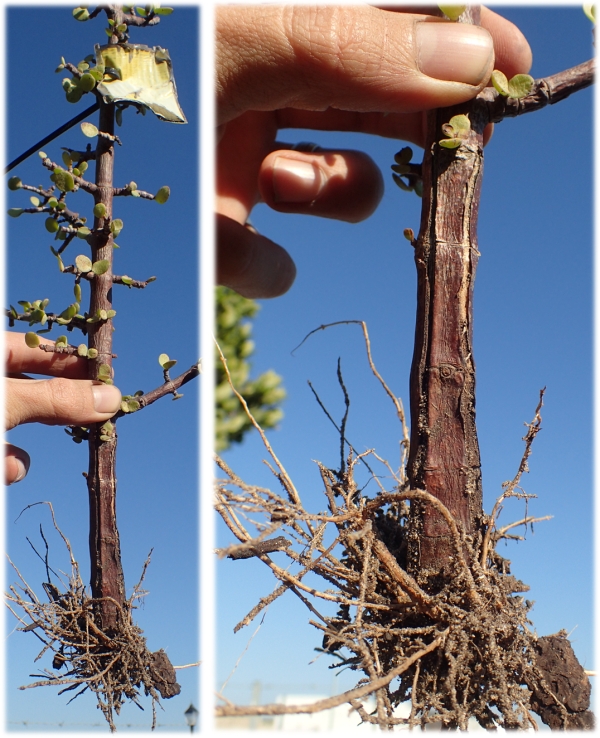
In a previous post (To the root of the problem...), I highlighted that the roots of planted truncheons invariably only grow from the very base of the stem — thus, rooting takes place 15-20 cm below the soil surface where the stem has been cut. This was based on a few field observations that have been bolstered by digging up many more plants (must be over 50 by now, all in very different environments). In that same post, I suggested that damage to the stem was required for roots to develop. Together with Nicholas Galuszynski, we had an Honours student conduct a series of treatments to determine if this stem-damage for rooting was correct. Unfortunately, the Honours student left with all the data (another lesson on data management for me), so I'm left with a few photos — but the results are, nonetheless, quite clear.

We had five treatments:


  1. Control, where the truncheon was cut and planted with no addition damaging.
  2. Vertical slits, where two shallow vertical slits were cut (quite shallow: <0.5 cm) for ~10 cm length-ways along the stem ending at the base where using the sharp blade of a pair of secateurs.
  3. Horizontal slits, where a number of horizontal slits were cut (also shallow) cross-ways across the stem. 
  4. Peeling, where the sharp secateur-blade was used to shallowly peel (or skin) the outer bark, and,  
  5. Deep gouging, where deep cuts were gouged into the stem.


And the overall results are summarised below with photos of single replicates.
1. Control: no roots along the stem


2. Vertical (or longitudinal cuts): no roots along the stem
However, there was some swelling at the base with more (visually assessed) root biomass.


3. Horizontal (or perpendicular cuts): no roots along the stem

4. Scraping: no roots along the stem


5. Vertical (or longitudinal cuts): hooray! roots along the stem
Rooting was consistent across stems with gouges, but not every gouge developed roots. Nonetheless, those that did not develop roots still healed over.

So, the deep gouging makes a substantial contribution to stimulating rooting. The great thing about these results is that they've been replicate by an independent experiment!

Thankfully, Yondela Norman — an Honours student at Rhodes University — conducted a completely independent and different experiment on rooting (at the same time as we were!) and also found that the deep gouges substantially promoted root growth. So, my predictions in this earlier blog were correct. It's great when the data actually supports a hypothesis.  

Wednesday, 20 September 2017

Thicket Restoration: Is Spekboom the only answer?

Restoring thicket has largely focused on using Portulacaria afra (spekboom), and to a much lesser extent on "late-successional" tree species, as the agents for returning ecosystem functioning. I write "late-successional" because we are a far way off from understanding the successional patterns in thicket; nonetheless, the case is quite well established that, in arid thicket, the presence of many tree species — such as Pappea capensis — is due to the presence of spekboom (e.g. van der Vyver et al., 2013). This is largely due to the increase in available soil moisture that is a by-product of a spekboom dominant layer (van Luijk et al., 2013; Wilman et al., 2014).

However, does this necessarily mean that spekboom is the best pioneer species to re-introduce or bolster into degraded lands? Recent field observations lead me to think that we might have overlooked an pioneer candidate: Crassula tetragona.

While looking investigating a donga (a dry gulley formed by erosion) in Addo that was surrounded by dense intact thicket, it struck me that although there were plenty of spekboom plants in the vicinity (e.g. the orange arrow in the picture below), I could only find one small individual in the donga — although, I argue elsewhere (The number one invasive species in arid lands globally: Spekboom?) that this is due to a lack of an adequate dispersal agent. What had colonised this inhospitable environment was Crassula tetragona (blue arrow in the picture below). Also, where it had colonised, colonies of clonelets were forming wherever leaf-clusters had broken off the parent plant. This clump is acting as a silt and litter trap, with the soil already at least 5 cm above the surrounding soil. This is an example of spontaneous rehabilitation and C. tetragona is changing the microclimate of this eroded donga testing.


However, this is in a herbivore-exclusion area and along a drainage line where there will be some moisture and soil (the donga had not hit bed rock yet). How will this species fair in a harsher environment?

Well, the images below were taken from Kaboega Private Game Reserve on a heavily eroded north-facing (and so hot!) slope. There is no topsoil - it is right down to the eroding shale bedrock.  The light green plants in the image below are C. tetragona. These plants are filling up the small rills on a slope where all the topsoil has been stripped off  — and they are doing it via vegetation growth: a crown piece gets knocked off (falls off?), and this readily takes root. This is an environment where a range of herbivores are present, including kudu and impala. Why is it not being eaten? This species is likely to be unpalatable (however, Curtis & Perrin, 1979, do list it as a preferred species for rodents).


In discussing this as an option with Jan Vlok, he highlighted that this is a species that does not do well in areas with high herbivore activity due to trampling. So some activity is okay, but not too much.

Given that this is a species that has is readily self-propagating across a range of arid and hot environments, it should certainly be considered as part of the rehabilitation suite. Coupling this with erosion control measures, such as mini-ponds, could provide the boost to create vegetated hotspots. 


References:
  • Curtis BA & Perrin MR (1979) Food preferences of the vlei rat (Otomys Irroratus) and the four-striped mouse (Rhabdomys pumilio). South African Journal of Zoology, 14:224-229. DOI: 10.1080/02541858.1979.11447675
  • van der Vyver ML, Cowling RM, Mills AJ, Difford M (2013) Spontaneous return of biodiversity in restored subtropical thicket: Portulacaria afra as an ecosystem engineer. Restoration Ecology 21:736-744.
  • van Luijk G, Cowling RM, Riksen MJPM & Glenday J (2013) Hydrological implications of desertification: Degradation of South African semi-arid subtropical thicket. Journal of Arid Environments 91:14-21.
  • Wilman, V, Campbell EE, Potts AJ & Cowling, RM (2014) A mismatch between germination requirements and environmental conditions: Niche conservatism in xeric subtropical thicket canopy species? South African Journal of Botany 92: 1-6.

Friday, 14 April 2017

Balancing drought versus herbivory survival in Spekboom restoration

by Alastair Potts

There are three major stresses that spekboom cuttings need to survive: drought, herbivory and frost. The last stress has been discussed in previous posts (see Rob Duker's "Thicket restoration and frost: the forgotten enemies") and can be overcome quite simply by avoiding areas that experience frosts.

Drought survival was the focus of initial spekboom restoration research. This suggested that smaller cuttings (so-called "fingerlings") had extremely low survival rates, and survival increased with the size of the cutting. This led to the suggestion of the current truncheon size of ~>4 cm stem diameter as part of the restoration protocol. 

These truncheons are planted to a depth of  ~10-20 cm (sometimes deeper) sticking upright out of the ground. In a previous post ("To the root of the problem with Spekboom restoration"), I highlighted that the roots tend to only grow from the cut base, which has been been buried deep in the soil and limiting the access the plant has to soil moisture after light rainfall events. However, an additional problem is that these cuttings take a long time to develop a root-to-shoot ratio that is sufficient to survive drought, but more importantly, withstand herbivory. 

A root-to-shoot ratio describes the amount of plant tissue that has supportive functions (i.e. the roots) relative to the amount of tissue that has growth functions (i.e. above-ground stems and leaves). Roots allow a plant to absorb water and nutrients from the surrounding soil, and thus root-to-shoot ratios are usually discussed in terms of plant health and water/nutrient absorption. This is certainly an important consideration for spekboom truncheons, but what is of greater importance is the effect that this low root-to-shoot ratio has on herbivory survival.

Without an established root system (relative to the above-ground plant), a spekboom truncheon is more susceptible to browsing and catastrophic herbivory-related uprooting. Browsers eating spekboom generally include a pulling motion after the bite; this pulling motion can easily uproot a truncheon. (Note that baboons have also been observed pulling up truncheons). 

Spekboom has evolved to withstand heavy browsing from indigenous game. Even in an area with arguably the highest elephant-browsing density in the world — at Hapoor Dam in Addo Elephant National Park where the elephants have decimated the thicket vegetation surrounding the dam (Landman et al. 2012) — spekboom is one of the first species to return to canopy dominance as you move away from the dam. Also, in relation to its annual rainfall, AENP supports the highest biomass of herbivores anywhere in Africa (Mills et al. 2014), and likely the world. As an aside, an untested hypothesis is that the primary dispersal agents of spekboom are elephants as there habit of walking while munching on a spekboom branch results in a rain of vegetative parts that can propagate new individuals.  

So, why are spekboom truncheons susceptible to indigenous herbivory? The root-to-shoot ratio is wrong. There is not enough going on under the ground to support what is going on above the ground.

We need the truncheons to be large to withstand drought-stress, but being large makes them more apparent in the landscape, take a long time to develop the necessary roots, and ultimately highly susceptible to herbivory.

How can we deal with this catch twenty-two?  

My suggestion is to return to smaller truncheon sizes (the "fingerlings"). The fingerlings:

  • are less apparent in the landscape, and
  • can develop the right root-to-shoot ratio in a shorter time period.
Also, this is how I imagine spekboom has been distributed through the landscape, via propagule-rain driven by elephant browsing. But this rain would have been throughout the year (not a once off planting as in restoration), and so the fingerlings would have been rained down during windows of opportunity and when establishment would not be possible (e.g. in droughts).     

Thus, this still leaves the problem of drought survival. A lone spekboom fingerling out in the open has little chance of survival. However, there are a few things that can be done to improve these chances:

  • Planting spekboom close together in a contoured band has been shown to have outstanding results at the Camdeboo National Park restoration sites established by Peter Burdett (results shared by Bruce Taplin at the Thicket Forum 2015). 
  • The pure mechanical effect of creating a contour line, by rip-ploughing, soil bags, car tyres etc. creates drainage lines of increased soil moisture. If positioned correctly, these lines can also create an ameliorated microclimate for a small plant.
  • Loosening the soil prior to planting has also been reported (reference needed) to improve truncheon survival and growth. 
  • Hydromulch, a woodfibre mulch applied with water and a tackifier (natural glue), traps water and dew and creates an excellent medium for encouraging root development in fingerlings (see the images in my post about the rooting window hypothesis).

Thus, the combination of mechanical contour ploughing that loosens the soil (or some other water-trapping technique) and creates microclimates (on south-facing micro-slopes in the ditch and in the soil), hydromulch and a high density of spekboom fingerlings could very well be the recipe for seeding the landscape with spekboom resilient to drought and herbivory. As the mechanical structure of the contour breaks down from erosion, the spekboom will likely take over as a biological contour, filtering water and erosion and increasing water infiltration. 

Monday, 5 December 2016

The Great Hydromulch Experiment: Roots in the drought


By Nicholas Galuszynski

Previously we highlighted what hydromulching was and how we planned on applying this technology to the restoration of Succulent Thicket. Since then we’ve all been waiting anxiously to find out what the outcome of spraying those huge amounts of water, wood-fiber, glue and spekboom into degraded thicket actually does. So three months after the treatment we returned to see what’s what and here’s what we saw. Firstly, three months is not nearly enough time to actually judge what the fate of the small spekboom branchlets (spekkies), plucked from their parent trees, will actually be, but if we find any signs of life in these little guys that will be a great sign.


Upon arrival at the experimental site it was clear that this area hasn’t had any rain recently, with all but the noors (Euphorbia) being little more than bunches of dry twigs reaching out from a sea of stone and dust. This was confirmed by our chance meeting with a local sheep farmer, on his way to collect water for his suffering flock he informed us that to his knowledge the area was in the grips of the worst drought since the 1910’s. 


Most of the vegetation in the area was exhibiting clear signs of stress, even the prickly pears (Opuntia sp.) were suffering.

Disheartened we walked to the first site. Here the treatment was to spray the spekkie/mulch mixture directly onto the exposed soils of the degraded veld. We were happy to see that the mulch had stayed exactly where it had been sprayed, but unfortunately none of the spekkies appeared to have survived being minced in the hyromulch tank and then sprawled out in the Jansenville sun for three months. In all honesty though, after seeing the state of the spekboom after being pumped though the hydromulch tank, we didn’t have very high hopes. The second site (with the same treatment as above) confirmed that placing spekboom directly into the tank was not going to work as again there was zero survival of the minced pieces of spekboom. Not only did it destroy the cuttings, during the day of the trial experiments the pump became blocked repeatedly. So if you are ever thinking of spraying spekboom through a hydromulch machine, don’t. 

At this point we had already looked at two of our three sites and it only took us less than an hour, thinking we were going to have an early day we checked out the final site. Here our treatment was a bit different, rather than putting the spekkies directly into the pump, we scattered them by hand and sprayed the mulch on top of them. As we approached the sprayed area we immediately noticed that we could actually find the cuttings and more surprisingly they were still green. This was starting to seem positive, these small cuttings still appear to be alive after three months of lying in the sun with little to no external moisture source (other than that provided by the mulch spray). To even greater amazement we found that many of these cuttings were starting to set root.

Surviving Spekkies were found bound in the hydromulch matrix which is likely acting as an important buffer between the cuttings and the harsh environment.

What we noticed was that spekkies ranging between 3 and 5 cm were more likely to have signs of roots than those of a larger size. It was amazing, one of these cuttings had even started flowering. The 3-5 cm size range was, unintentionally, the most common sized piece of spekboom plucked during the setup of the experiment. Only noticing this on our follow up visit did we realise that it was because it is the most common branchlet size range to occur on the surrounding spekboom. Whether this is as a result of herbivory or the environment and whether this phenomenon occurs elsewhere is unknown. However, if this sized branchlet is a common feature of spekboom morphology, could it also be an important component of this plants ability to clonally spread through herbivore mediated disturbances?

Another aspect of these plucked branches that we considered to be an important attribute, potentially aiding in the survival and establishment of these spekkies, was the fact that the roots were consistently located on the section of the removal point that was not scarred. This should be considered in comparison to cuttings taken using sheers, where the entire cross-section of the branch should be considered as the scarred area and a sight for water loss and infection. Plucked cuttings on the other hand have a reduced scarring area, potentially reducing water loss and vulnerability to pathogens. 


Cuttings plucked at around 5 cm in length

Traditional spekboom restoration activities are also taking place in the area surrounding our experimental sites, allowing for quick in field comparisons between the success of our approach and that of the traditional approach. While previous attempts at truncheon planting yielded little positive results, the more recent plantings in the area (truncheons planted after we set up our experiment) appear to be surviving and a number of adhoc experiments appear to be taking place through the initiative of the implementers managing that process. After digging up some of the recently planted truncheons we notice that they were also frequently exhibiting rooting activity! While those planted months before had no roots, were more prone to below ground termite damage and rarely showed any signs of life. Furthermore, cuttings that had flower buds present generally had root activity more often than those with no flowers, and truncheons planted within and around bush clumps generally had more flowers than those out in the open. Could this be an indication that there is a time of year (flowering season) when it is better to plant spekboom cuttings? All we know is that while it may be too soon to claim hydromulch based spekboom planting as the saviour of succulent thicket, it definitely has the potential to change our approach to restoring this ecosystem. But only time will tell. And only if you don't put the spekboom through the hydromulcher!